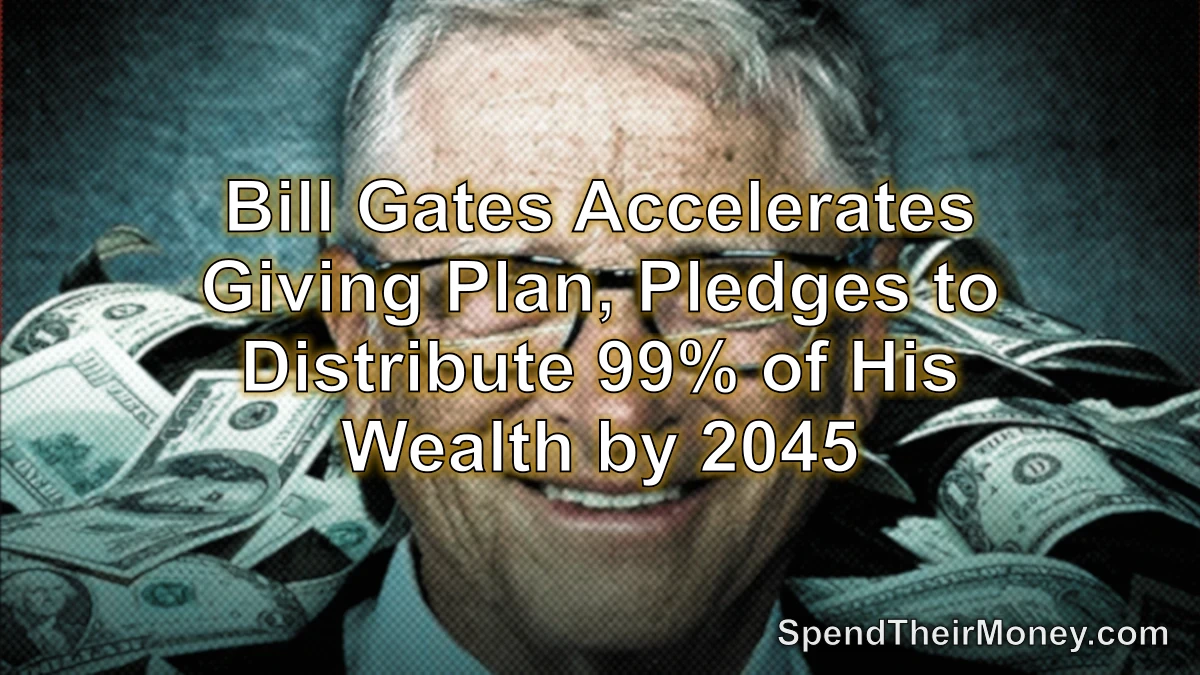
Bill Gates is doubling down on his commitment to give away nearly all of his fortune—and fast.
The Microsoft co-founder announced he plans to distribute around $200 billion of his wealth over the next 20 years, accelerating his original timeline and signaling a major shift in his philanthropic game plan.
Founded in 2000 with then-wife Melinda French Gates, the Bill & Melinda Gates Foundation has been a powerhouse in global health, education, and poverty alleviation, spending over $100 billion to date.
But now, Gates is making it clear: the foundation will wind down by December 31, 2045, with the goal of giving away virtually all of his remaining wealth before then.
“People will say a lot of things about me when I die, but I am determined that ‘he died rich’ will not be one of them,” Gates wrote in a blog post titled “The Last Chapter.” This blunt declaration underscores his urgency to tackle global problems head-on, rather than waiting decades to distribute his fortune.
His decision comes amid a turbulent political climate, with cuts to U.S.
foreign aid and global health funding under the Trump administration threatening to stall progress in critical areas.
Gates is betting that fast-tracking his giving will help fill those gaps and inspire other billionaires to step up their game.
Gates’ plan isn’t just about writing big checks—it’s about doubling down on impact.
The foundation aims to pour money into ending preventable deaths of mothers and babies, eradicating infectious diseases, and lifting millions out of poverty, especially across Africa.
During a recent speech in Addis Ababa, Ethiopia, Gates emphasized the role of health and education in unlocking human potential, urging young African innovators to harness technologies like artificial intelligence to revolutionize healthcare on the continent.
But this accelerated giving spree comes with a definitive end date: the Gates Foundation will close its doors in 2045.
That’s a dramatic shift from the original plan to keep the foundation running for decades after Gates’ death, signaling confidence that their goals can be achieved sooner.
Mark Suzman, the foundation’s CEO, explained that the board approved this new timeline to provide more certainty to partners and double down on key investments.
The foundation’s current endowment stands at $77 billion, but Gates’ ongoing donations will push total spending well beyond $200 billion by the time it closes.
Gates’ philanthropic journey has been a model for the ultra-wealthy, especially since launching the Giving Pledge in 2010 alongside Warren Buffett and Melinda French Gates.
The pledge encourages billionaires to commit the majority of their wealth to charity, and now boasts over 240 signatories.
Yet, Gates’ latest move raises the bar, emphasizing not just the amount but the speed of giving.
It’s a challenge to his peers to rethink how quickly they put their money to work in solving the world’s biggest problems.
Still, this isn’t just a feel-good story. The stakes are high: with global health and development funding under threat, the foundation’s accelerated spending could be a lifeline for millions.
Its focus on maternal health, nutrition, and infectious diseases aims to save tens of millions of lives in the coming decades.
As Gates himself put it, “There are too many urgent problems to solve for me to hold onto resources that could help others.”
While Gates will remain a billionaire even after giving away 99% of his fortune, his decision to close the foundation by 2045 marks a turning point in modern philanthropy.
It’s a bold bet that concentrated, accelerated giving can deliver results faster—and that the era of slow, generational wealth transfers might be coming to an end.
Whether other billionaires follow suit remains to be seen (albeit unlikely), but one thing is clear: Bill Gates is rewriting the rules on how the ultra-rich give back.