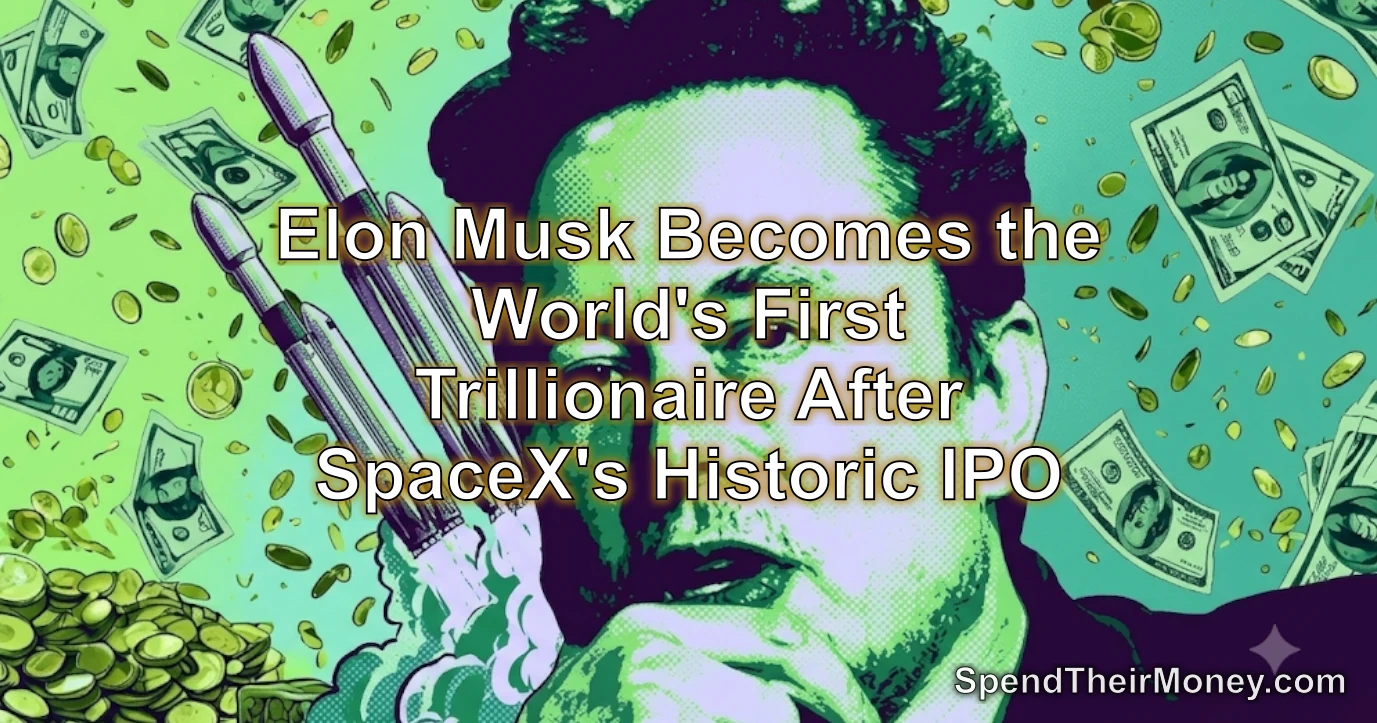
It happened. The number that's been thrown around as a hypothetical for years quietly became reality on Friday, June 12, 2026: Elon Musk crossed the $1 trillion mark in personal net worth, making him the first private individual in recorded history to do so.
The catalyst? SpaceX — the rocket company Musk founded in 2002 on a dream of colonising Mars — finally made its long-awaited debut on the public stock markets, and the reaction was nothing short of explosive.
SpaceX has for years been the crown jewel in Musk's portfolio, valued at staggering sums in private funding rounds but never available to ordinary investors on an exchange. That changed on Friday, and the market responded with the kind of enthusiasm usually reserved for the most hyped debuts in Silicon Valley history.
The IPO sent Musk's total estimated net worth soaring to approximately $1.11 trillion, according to Bloomberg's Billionaires Index — a figure so large it barely feels real.
To put it in perspective: that's not $1.11 billion with a "b." That's $1,110,000,000,000. Eleven hundred and ten billion dollars. More money than most countries produce in a year.
The gap between Musk and the rest of the ultra-wealthy is now almost comically wide. The closest challengers — Google co-founders Larry Page and Sergey Brin, Amazon's Jeff Bezos, and LVMH boss Bernard Arnault — are all still firmly in billionaire territory, nowhere near cracking the twelve-digit ceiling Musk just blew through.
Even the most optimistic forecasts for the runners-up would put them tens, if not hundreds, of billions short of where Musk stands today.
SpaceX's valuation is the centrepiece, but Musk's $1 trillion fortune is the sum of an entire ecosystem of companies. Tesla, despite its volatile share price in recent years, remains one of the world's most valuable automakers. X (formerly Twitter) continues to operate under Musk's ownership. xAI, his artificial intelligence venture, has attracted billions in investment as the AI arms race intensifies. Neuralink and The Boring Company round out a portfolio that spans electric vehicles, social media, rockets, brain-computer interfaces, and underground tunnels.
No one in history has simultaneously run this many high-stakes, capital-intensive companies — which makes the trillion-dollar milestone feel, in some ways, inevitable in hindsight.
The reaction online was predictably split. Supporters celebrated it as the ultimate validation of Musk's vision — a self-made immigrant who bet everything on seemingly impossible ideas and won on a scale nobody had ever managed. Critics pointed out that no individual should hold wealth equivalent to the GDP of a mid-sized nation, and that the milestone raises serious questions about power, taxation, and inequality in the modern economy.
Musk himself, true to form, marked the occasion on X with characteristic brevity.
Whatever your take on the man, the number is historic. The "trillionaire" label has existed in dictionaries and hypothetical lists for a while, but it was always a futurism talking point — something that might happen someday, maybe. On Friday the 12th of June, 2026, someday arrived.
Now comes the obvious question: how do you even begin to spend $1.11 trillion? We have some ideas — try spending it yourself and see how far you get.